


Carry-on Test 2026: Ryanair, Lufthansa, easyJet & Co.
Which carry-on luggage can you take for free – and which suitcase really fits which airline? In our comprehensive carry-on luggage test, five typical pieces of luggage (hard-shell suitcase, travel bag with wheels, nylon bag, leather weekender, and travel backpack) were compared against the official carry-on guidelines of ten airlines – from Ryanair and Wizz Air to Lufthansa and Air France. You'll find out which dimensions and weights will apply in 2026, what has changed with the new "Economy Basic" fare of the Lufthansa Group, and which model is the only one accepted by all ten airlines.

Niklas Wachter
Brief and concise: the most important things in advance
Since 2026, there have been two categories for hand luggage: The first is a small piece of luggage for the space under the front seat, usually free of charge and approximately 40 × 30 × 15 to 20 cm in size. The second is the large cabin luggage for the overhead compartment, often subject to a fee and usually 55 × 40 × 20 to 23 cm with 8 to 10 kg. The fare is crucial: if you book the basic fare with a budget airline, you can usually only take the small piece of luggage free of charge.
An overview of the most important airlines
- Ryanair and Vueling: The small piece of luggage up to 40 × 30 × 20 cm is free of charge; the large one (55 × 40 × 20 cm, 10 kg) is only available for an extra charge (Priority or higher fare). With a maximum depth of 20 cm, this is the strictest requirement in the entire test.
- Lufthansa, Swiss and Austrian: Trolley up to 55 × 40 × 23 cm with 8 kg, but since the new "Economy Basic" fare (May 19, 2026), it is only available for an extra charge.
- Eurowings: In BASIC, only the small piece of luggage (40 × 30 × 25 cm) is free of charge; the trolley (55 × 40 × 23 cm) is only available from SMART.
- easyJet: the most generous free piece of luggage in the test (45 × 36 × 20 cm, 15 kg); the large format (56 × 45 × 25 cm) is subject to a fee.
- Wizz Air: The small piece of luggage (40 × 30 × 20 cm) is free of charge; the trolley (55 × 40 × 23 cm) is only available with WIZZ Priority.
- KLM and Air France: Trolley 55 × 35 × 25 cm with only 35 cm width, 12 kg including personal item; subject to a fee in the Basic or Light fare.

Our test winner: PARIS 2.0, expandable travel bag with wheels
The expandable travel bag with wheels Paris 2.0 is the only model to pass the large cabin baggage test with all 10 airlines tested. The variable depth is decisive: folded to 17 cm, it even meets the 20 cm limit of Ryanair and Vueling, and with a width of 29 cm, it falls below the narrow 35 cm limit of KLM and Air France.
In addition, the travel bag offers a generous interior with various inner compartments and comfortable carrying thanks to the padded & adjustable shoulder strap. At the same time, it is one of the lightest models at 1.4 kg empty and the cheapest model in the test at €49.90.
Die komplette Airline-Übersicht 2026
Die folgende Tabelle führt für jede Airline beide Kategorien auf: das kostenlose kleine Handgepäck unter dem Vordersitz und das große Kabinengepäck im Gepäckfach. Sämtliche Werte wurden Juni 2026 direkt auf den offiziellen Airline-Seiten geprüft.
| Airline | Kleines Handgepäck | Großes Kabinengepäck | Max. Gewicht | Großes Teil im Basistarif inkl.? | Quelle |
|---|---|---|---|---|---|
| Ryanair | 40 × 30 × 20 cm | 55 × 40 × 20 cm | 10 kg großes Teil | Nein, nur mit „Priority & 2 Cabin Bags“ | help.ryanair.com |
| Lufthansa | 40 × 30 × 15 cm | 55 × 40 × 23 cm | 8 kg Trolley | Nein im Economy Basic seit 19.05.2026; sonst ja | lufthansa.com |
| Eurowings | 40 × 30 × 25 cm | 55 × 40 × 23 cm | 8 kg Trolley | Nein im BASIC; ja ab SMART | eurowings.com |
| easyJet | 45 × 36 × 20 cm | 56 × 45 × 25 cm | 15 kg je Teil | Nein, kostenpflichtig mit Standard Plus, FLEXI oder easyJet Plus | easyjet.com |
| Wizz Air | 40 × 30 × 20 cm | 55 × 40 × 23 cm | 10 kg Trolley | Nein, nur mit WIZZ Priority | wizzair.com |
| KLM | 40 × 30 × 15 cm | 55 × 35 × 25 cm | 12 kg gesamt, Economy | Nein im Economy Basic; sonst ja | klm.com |
| Swiss | 40 × 30 × 15 cm | 55 × 40 × 23 cm | 8 kg Trolley | Nein im Economy Basic seit 19.05.2026; sonst ja | swiss.com |
| Vueling | 40 × 30 × 20 cm | 55 × 40 × 20 cm | 10 kg großes Teil | Nein, nur in höheren Tarifen wie Optima oder Fly Grande | help.vueling.com |
| Austrian | 40 × 30 × 15 cm | 55 × 40 × 23 cm | 8 kg Trolley | Nein im Economy Basic seit 19.05.2026; sonst ja | austrian.com |
| Air France | 40 × 30 × 15 cm | 55 × 35 × 25 cm | 12 kg gesamt, Economy | Nein im Basic oder Light; sonst ja | airfrance.de |
Hinweis: Welche Maße und Gebühren konkret gelten, richtet sich nach dem gebuchten Tarif, der Reiseklasse und der Strecke und kann sich kurzfristig ändern. Vor jedem Flug empfiehlt sich daher ein Blick auf die aktuelle Angabe der offiziellen Airline-Seite. Die Gewichtsangaben beziehen sich je nach Airline auf das einzelne Gepäckstück Ryanair, Wizz, LH-Gruppe oder auf Handgepäck und persönlichen Gegenstand zusammen KLM, Air France.
Which product fits which airline?
Five typical hand luggage categories were tested, from classic wheeled suitcases to travel backpacks, each with one example product. "Fits" means that the model, as large cabin luggage (overhead compartment), complies with all three external dimensions of the respective airline. Whether this large piece of luggage is free depends on the fare (see table above).

FERGÉ Cannes Carry-on Suitcase

SONS OF ALOHA Suitcase KANE

FERGÉ PARIS 2.0 Wheeled Travel Bag

SID & VAIN Leather Travel Bag LANDON

SONS OF ALOHA Travel Backpack AHI

How we tested (test methodology)
For each of the five models, the external dimensions including wheels and handles, as well as the empty weight, were recorded and compared with the official carry-on luggage requirements of the ten airlines (see table for sources, retrieved on June 3, 2026). The rating "fits" is only given if all three external dimensions are below the respective airline limit. In contrast to hard-shell suitcases, the volume of soft models made of nylon and leather in the luggage compartment can be adjusted slightly.
In addition, the models were tested for three weeks under real conditions. The suitcases, travel bags, and backpacks were used on short trips, weekend trips, and in everyday life. Among other things, packing volume, carrying comfort, wheel movement, stability, access to compartments, workmanship, zippers, handles, and suitability for everyday use when stowing in the car, on the train, and on the plane were evaluated.
To make the actual usable interior volume comparable, each model was also measured with water. For this purpose, the main compartments were completely filled, and the measured quantity was converted into liters. Separately unusable cavities, severely restricted outer compartments, and manufacturer's volume specifications were not used as the sole basis. The decisive factor was how much storage space was actually available in practical use.
The final evaluation therefore combines three perspectives: firstly, the objectively measured dimensions and weight, secondly, the real usable volume, and thirdly, the practical experience from the three-week test. This allows for a better assessment of which model is not only suitable as carry-on luggage on paper but also proves itself in everyday travel.

FERGE
Carry-on suitcase CANNES
55 × 35 × 22 cm | 2.9 kg, 38l | ABS + Polycarbonate | 69.90 €
The hardshell suitcase is the most robust solution in the test and offers the most reliable protection against pressure. At 2.9 kg, it is also the heaviest model, which leaves about 5 kg of additional luggage capacity for the Lufthansa Group's 8 kg limit. The real sticking point is its fixed depth of 22 cm. Since a hardshell cannot be compressed, the suitcase fails to meet Ryanair and Vueling's 20 cm requirement.
- Advantages: dimensionally stable protection; TSA combination lock; four wheels for 360° maneuvering; cabin-compatible with 8 out of 10 airlines.
- Disadvantages: 22 cm depth too much for Ryanair and Vueling; at 2.9 kg, the highest empty weight; rigid construction with no leeway at the gate.
Suitable for: Lufthansa, Swiss, Austrian, Eurowings (from SMART), KLM, Air France, easyJet, Wizz Air.

Sons of Aloha
Trolley KANE
50 × 40 × 20 cm | 2.4 kg, 44l | recycled nylon & polyester | €69.90
The KANE travel trolley offers the largest volume at 44 l and a moderate weight of 2.4 kg. With a depth of exactly 20 cm, it is also approved by Ryanair and Vueling. The width is limiting: 40 cm is 5 cm over the limit for KLM and Air France (maximum 35 cm). The recycled PET material also offers solid robustness, especially for longer journeys, while remaining soft enough for extra leeway.
- Advantages: 44 l at 2.4 kg; 20 cm depth approved by Ryanair and Vueling; soft fabric with some leeway.
- Disadvantages: 40 cm width too much for KLM and Air France; only two wheels instead of four.
Suitable for: Ryanair, Vueling, Lufthansa, Swiss, Austrian, Eurowings (SMART and above), easyJet, Wizz Air.

FERGE
Wheeled Travel Bag PARIS 2.0
55 × 29 × 17–38 cm (depth adjustable) | 1.4 kg, 51–64l | Nylon | €49.90
The PARIS 2.0 is the only travel bag that qualifies as a large cabin bag with all ten airlines, making it the test winner. The variable depth is crucial: reduced to 17 cm, it even meets the 20 cm limit of Ryanair and Vueling; with a width of 29 cm, it stays below the narrow 35 cm limit of KLM and Air France. At 1.4 kg, it is one of the lightest models, and at €49.90, it is the most affordable in the test. For more storage space, the depth can be extended to 38 cm, although in this configuration, it is only allowed as checked luggage.
- Advantages: cabin-friendly with all 10 airlines (depth 17 cm); lightest model (1.4 kg); best price; expandable to 51 to 64 l; separate shoe compartment and various interior pockets.
- Disadvantages: when fully expanded (38 cm), no longer carry-on luggage; the soft material offers less impact protection than a hard shell.
Suitable for: all 10 airlines tested.

SID & VAIN
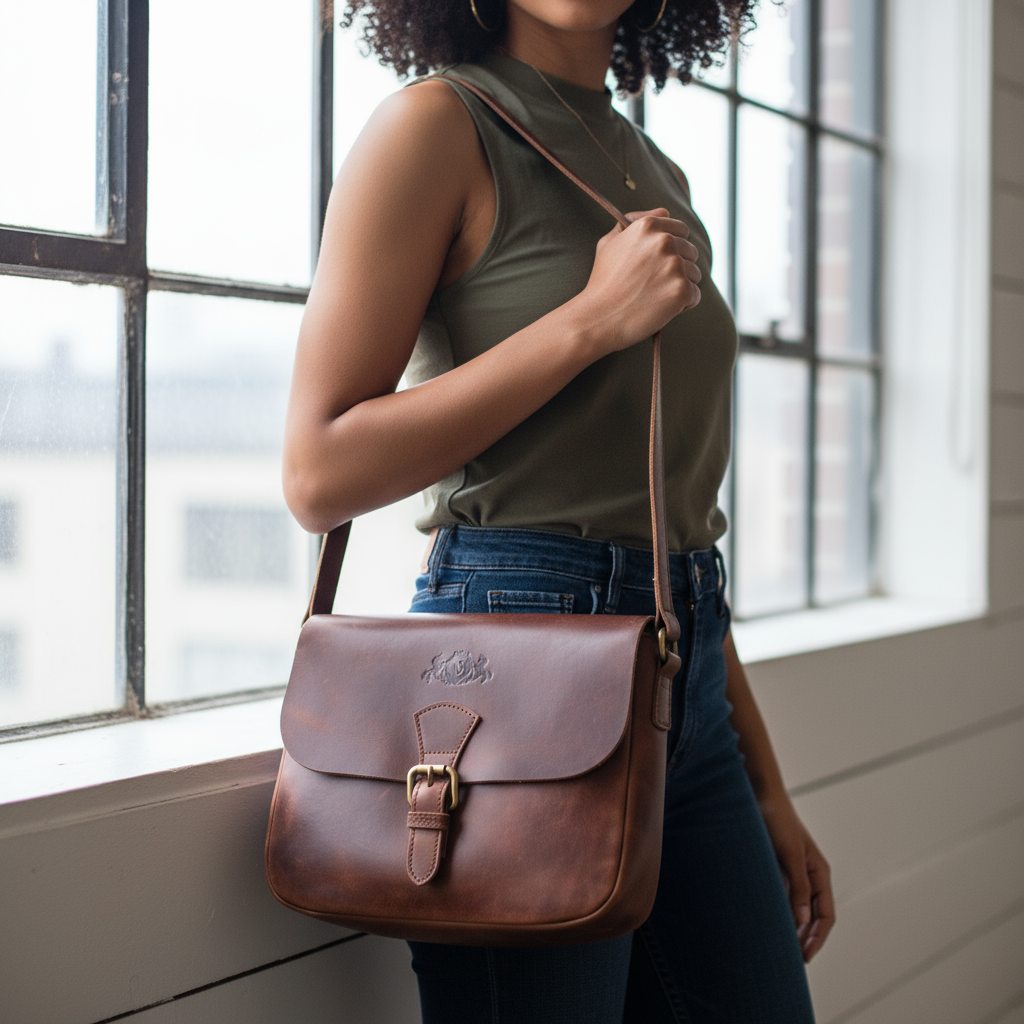
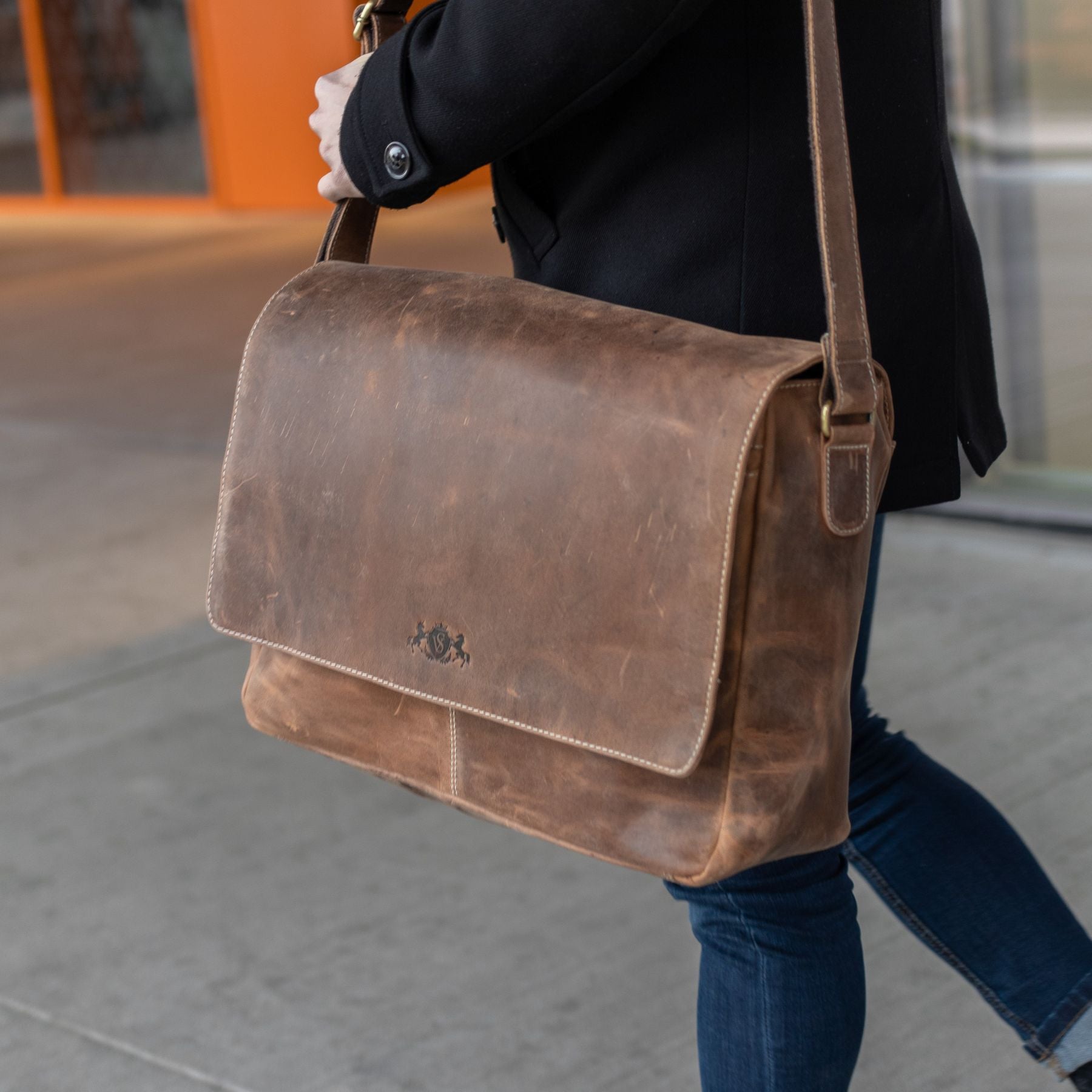
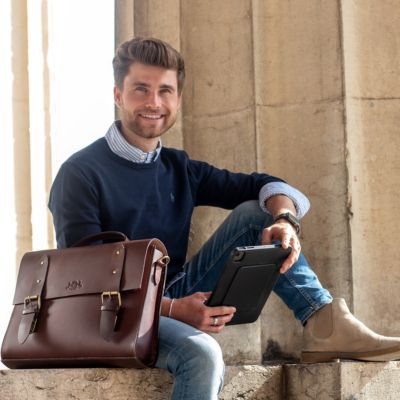
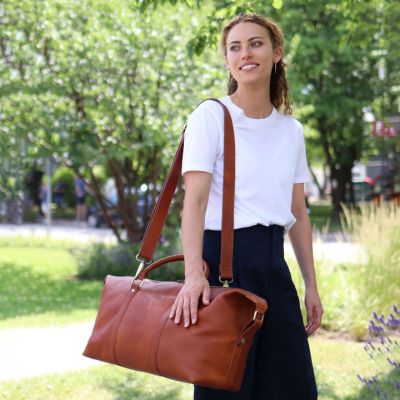
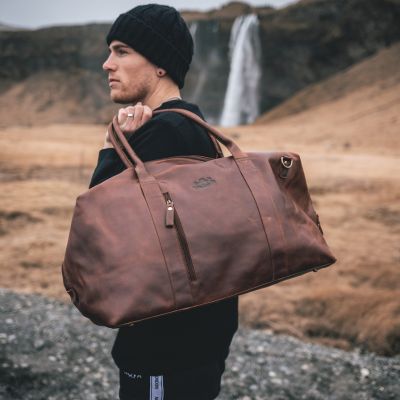
Weekender LANDON
50 × 25 × 22 cm | 1.5 kg, 40l | Goatskin Leather | €89.90
LANDON is the stylistic choice in the test, and the size is crucial here. The small version (50 cm length) of the Leather Weekender is cabin-approved by 8 out of 10 airlines, but with a depth of 22 cm, it fails with Ryanair and Vueling. The soft leather still offers some flexibility here, but above all, it convinces with its pleasant feel and robust craftsmanship.
- Advantages: Shoe compartment and front pocket; detachable shoulder strap; small version is cabin-approved by 8 out of 10 airlines.
- Disadvantages: High-quality leather results in a higher price; more sensitive to moisture than nylon or tarpaulin.
Suitable for (small version): Lufthansa, Swiss, Austrian, Eurowings (from SMART), KLM, Air France, easyJet, Wizz Air.

SONS OF ALOHA
Travel Backpack AHI
47 × 29 × 15 cm | 1.3 kg, 21l | waterproof 1000D Tarpaulin | €99.90
At 1.3 kg and 21 l, AHI is the most compact companion in the test. As a large carry-on bag, the travel backpack is unproblematic, as its dimensions of 47 × 29 × 15 cm are below the limit for all ten airlines. However, as a free personal item under the seat, its height of 47 cm is too tall for almost all airlines (the limit is usually 40 cm, with easyJet at 45 cm). If you want to take it for free, you usually need space in the overhead bin or the more generous allowance of easyJet, where it only slightly exceeds the limit.
- Pros: waterproof tarpaulin; 15" laptop compartment; trolley sleeve for attaching to a suitcase; fits in the overhead compartment everywhere; only 1.3 kg.
- Cons: smallest volume at 21 l; usually too large as a free under-seat item with a height of 47 cm.
Suitable for: all 10 airlines as a large carry-on bag; only limited suitability as a free personal item.
Frequent questions about airlines & hand luggage (FAQ)
There is no uniform rule; airline and fare are decisive. As a general rule: The small item of luggage under the seat in front usually measures 40 × 30 × 15 to 20 cm (easyJet 45 × 36 × 20 cm), the large cabin luggage for the overhead compartment usually 55 × 40 × 20 to 23 cm and weighs 8 to 10 kg. KLM and Air France allow 55 × 35 × 25 cm and 12 kg, but this includes a personal item.
With traditional airlines (Lufthansa, Swiss, Austrian, KLM, Air France), this is possible: one large carry-on bag plus a small personal item like a backpack or laptop bag. However, with low-cost airlines on basic fares (Ryanair, Wizz Air, Vueling, Eurowings BASIC), this is not allowed. There, only one small piece of luggage is free of charge.
Clothing, electronics, medications, valuables, and liquids up to 100 ml per container are permitted. Weapons, sharp or pointed objects (blades over 6 cm), flammable materials, and fireworks are prohibited. Power banks and spare batteries must be carried in hand luggage and not in checked baggage.
As many as fit into a single transparent, resealable 1-liter bag (approx. 20 x 20 cm), which in practice means around 8 to 10 containers. Each individual container may hold a maximum of 100 ml, even if it is not completely full. One such bag is permitted per person.
This includes not only drinks but also gels, pastes, creams, and sprays, such as toothpaste, yogurt, deodorant spray, perfume, sunscreen, lip balm, mascara, or liquid foods. Solid substances like bars of soap or solid deodorants are not included.
Smartphones, laptops, tablets, cameras, and e-readers are permitted. Power banks and lithium batteries must be carried in hand luggage. Stricter rules have applied to the Lufthansa Group (Lufthansa, Swiss, Austrian, Eurowings, Brussels) since January 15, 2026: a maximum of two power banks per person, storage on the body or under the seat and not in the overhead compartment, and no charging on board. E-cigarettes are also only allowed in hand luggage and must remain switched off.
Weapons and weapon replicas, knives and blades over 6 cm, large scissors and tools, flammable liquids and gases, fireworks, and all items that violate EU aviation security regulations are prohibited. Such items, if permissible at all, belong in checked baggage.
Three points are relevant for 2026:
- Already in effect: The Lufthansa Group (Lufthansa, Swiss, Austrian, Eurowings, Brussels) introduced the "Economy Basic" fare on May 19, 2026. On short and medium-haul flights, it no longer includes a free trolley, but only a personal item (40 × 30 × 15 cm). In addition, stricter power bank rules (maximum two per passenger) have been in effect since January 15, 2026.
- Planned, but not yet in effect: In January 2026, the EU Parliament voted overwhelmingly in favor of allowing every passenger to carry one personal item and one piece of hand luggage (up to 100 cm total dimensions, 7 kg) free of charge. However, this regulation still needs to be negotiated with the EU Council; until then, the published airline rules remain in effect.
- Industry Standard: The airline association A4E has voluntarily agreed on a uniform size for small under-seat luggage: 40 × 30 × 15 cm. easyJet maintains its larger format of 45 × 36 × 20 cm.
5. Concluding Summary: Our Top Picks
After a detailed analysis of workmanship, functionality, and style, we present our findings for 2026:
Best Value for Money: The PARIS 2.0 impresses with an exceptionally good price-performance ratio. For a very low price of €49.90, you get a wonderfully lightweight model (1.4 kg) that, thanks to its variable depth, qualifies as large cabin luggage on all ten airlines. The combination of low weight, expandable storage space (51 to 64 liters), and the universally accepted 17 cm depth makes this travel bag the safest choice for anyone who wants to pack independently of airlines.
Personal Recommendation: LANDON is another personal recommendation in our test. It offers a balanced combination of high-quality goat leather, a well-designed interior with a shoe compartment, and comfortable carrying options via two handles or the detachable shoulder strap. In the small version (50 cm), this weekender is cabin-friendly on 8 out of 10 airlines, making it the right choice for anyone who values aesthetics and material quality as much as pure functionality.
But no matter which model you choose: the best hand luggage largely depends on your personal use case and preferred airline. Those who primarily fly with budget airlines will benefit from a flexible bag that also adheres to the strict 20 cm depth; those who need maximum protection will opt for a robust hardshell suitcase. Depending on the type of trip you are embarking on, you should consider beforehand which aspects are most important to you.
If you are still unsure, you can find our Hardshell vs. Softshell Suitcase Test here, which provides a particularly detailed overview of the advantages of different types of travel bags & suitcases.
All airline information was taken from official airline websites on June 3, 2026. Dimensions, fees, and tariffs may change at short notice; the airline's information at the time of booking is always binding.